Monday, 23 May 2011

Hiss & Shake - Legg's Eleven pt. 7

“Unfinished Sympathy’s more politicised and less agonised twin entered the charts on the same day – signalling a new start for British black music,” stated Garry Mulholland boldly, writing about the Young Disciples’ Apparently Nothin’, in his excellent book This Is Uncool. Much has been written about Massive Attack and the Bristol blues and roots. It is a fascinating subject, after all. But the Young Disciples’ story has a similarly rewarding tangle of sources to explore. And in many ways it covers stranger territory because of the way they only left us the one big statement, the Road To Freedom LP, which they have resolutely refused to expand upon or follow-up.

The Young Disciples’ Femi and Marco emerged from the late ‘80s London rare groove and hip hop scenes, and this background is as celebrated in their music as the reggae sound systems and post-punk influences in the Massive Attack mix. Road To Freedom was an unapologetically fragmented work, featuring contributions from London’s ‘positivity’ pioneers I.G. Culture (then with Dodge City productions), Outlaw Posse, and M.C. Mell ‘O’ (whose Thoughts Released has been salvaged by Original Dope imprint and sounds amazing, with Mell ‘O’ and DJ Pogo giving the Gang Starr guys some competition ... I wish I had realised that at the time), and a drift towards the jazzy abstract hip hop instrumentals which would come to the fore as the ‘90s progressed.

The performances of Shara Nelson and Carleen Anderson on Unfinished Sympathy and Apparently Nothin’, respectively, still grab the listener by the throat. It’s interesting that both singers had impeccable credentials. Shara had links with On-U Sound through the ‘80s, and Carleen’s parents had been part of James Brown’s inner circle. You can just imagine the ‘click’ moment when Femi and Marco met Carleen, heard her sing, and realised who her parents were. The same thing must have happened when Neneh Cherry met The Pop Group crowd. But whereas Neneh was a wild child, Carleen when she met the YDs had endured trouble and strife, and she caught something of that in her lyrics magnificently. Apparently Nothin’, in particular, has one of the most uncompromising of openings: “A popularity of invasion. Handed down through centuries. A force of arms called gentle persuasion. What have we learned from history?”

One young singer who perhaps did benefit from the success of the Young Disciples and Massive Attack was Des’ree. There is a direct link, too, as Sun of ’79 on her debut LP Mind Adventures was produced by the Young Disciples and engineered by Brendan Lynch. Oddly it is the only track on that LP that sounds tied to a particular place and time. The LP’s main producers, Phil Legg and/or Ashley Ingram, generally captured a very classy sound that is strangely warm and wonderfully understated. Perhaps Phil Legg had learned some valuable lessons about restraint from his time working at Robin Millar’s Powerplant studios in the late ‘80s.

While Des’ree’s debut certainly connects with the British radical tradition of Joan Armatrading and Linda Lewis, there is something about it that suggests the work of singer/songwriters like Carole King and Laura Nyro in the 1970s where their work was so steeped in soul music, the same soul music their songs helped shape. I am thinking of records like Fantasy, Music, Rhymes & Reasons, Smile, Nested ( light pop’s principle!); the sort of record that gradually improves with each subsequent listening over the years, like Des’ree’s Mind Adventures. I am also trying to resist picking up on any coincidence about Laura singing Desiree on Gonna Take A Miracle.

Feel So High was the song that introduced Des’ree to the world. It was one of those songs that seemed to come out of nowhere, and every time it came on the radio you found yourself holding your breath. There were a few soul records around in the early ‘90s that had the same effect, like Dreams by Gabrielle and Revival by Martine Girault, and still do. Maybe it was something in the air at the time, a certain climate. Since then there’s been a great procession of subversive soul (or call it what you like) that has often been the most inventive music around if not always the most successful in terms of sales and recognition.

Ashley Ingram as one of the producers behind Mind Adventures was well placed to bring a touch of subtle subversion to the proceedings. He was a member of Imagination, who turned pop music upside down when they appeared on the scene in the early ‘80s. The story of Imagination is one of the strangest in pop. Three guys with a very definite idea about what they want to do in terms of creating a slinky, erotic sound enter a partnership with unknown producers Swain & Jolley and hit the jackpot straight away with Body Talk. A string of hits followed, which sounded fantastic on the radio but the impact of Imagination reverberated right around.

You can hear the influence of Imagination on some of the other acts of the day. Orange Juice, circa Rip It Up, spring to mind (with the squelchy bass lines) as typical of groups graduating through punk and wanting to stretch themselves. While Edwyn and the OJs camped it up to annoy neds, Imagination vamped it up altogether more spectacularly with a series of provocative prime time Top of the Pops appearances that played havoc with traditional ideas about black pop presentation and which no doubt had many Sun readers spluttering in disbelief. Prince, I’m sure, would have been taking notes about the Imagination approach.

Imagination’s masterstroke was to release Nightdubbing, a collection of disco dub reworkings of their hits. More than just clever punning, these were fantastic re-imaginings of what were already adventurous works. What made the move even more bizarre was that the production team of Swain & Jolley were not known as experimentalists in the way, say, Martin Rushent or Martin Hannett were. Indeed the acts Swain & Jolley are most closely associated with are Spandau Ballet and Bananarama. Larry Levan was responsible for one of the Nightdubbing mixes (despite the tricks of history neither he nor Paradise Garage were household names in the UK in 1983), and it’s not exactly stretching things to note similarities between what Imagination were doing and what Levan would do with the Peech Boys. And, it has to be mentioned, the Peech Boys’ Bernard Fowler would become involved with Adrian Sherwood and the On-U Sound family whose influence on Massive Attack has been well noted.

Friday, 20 May 2011

Hiss & Shake - Legg's Eleven pt. 6


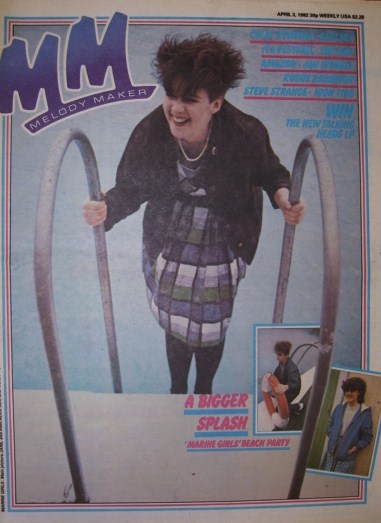
The Marine Girls’ Lazy Ways is a wonderful example of how to hold your nerve. It is one of the most spectacularly strange and strong-minded records ever. Stuart Moxham has quipped, self-deprecatingly, that as producer all he had to do was get Phil Legg to record the group in the Cold Storage studio and add a few overdubs. The miracle is that Stuart and all involved left it at that, resisting the urge to add embellishments like keyboards, drums, programming. That will have taken a real stubbornness by the Marine Girls, a definite boldness by the production team, and a degree of contrariness by the record label Cherry Red. Now it all seems delightfully perverse.
Beach Party by the Marine Girls had been a revelation when it first appeared. Partly it was a defiant statement about what you could get away with. But much, much more than that, it was about its participants being blessed with a very real talent for creating unique and gloriously catchy pop music. That record would never have caught on so dramatically if it wasn’t brimming over with infectious melodies and choruses that stayed with you, resolutely. Even now you can go for years without playing Beach Party but still instantly hum a refrain from In Love, Flying Over Russia, or He Got The Girl.
The Marine Girls thrived in an emboldening DIY environment, fuelled by early Postcard and Rough Trade singles, the odd things John Peel played on the radio, and an unofficial network of fanzines and local gigs. The appeal of Beach Party was that it was something you could feel very much part of. These were people the same sort of age, with the same taste, attitudes. There was a sense of belonging or at least identification, momentarily. But things in those days moved very quickly, attentions drifted, people got into different things, and they drifted apart. The story of the Marine Girls echoed the stories of what happened to us and our friends.
Lazy Ways is almost clinically stark, predominantly just bass and voice, with acoustic guitar in the background, and some sparse percussion. I now prefer it to the warm clatter of Beach Party, but I didn’t at the time. It’s tempting to expand on the presence of Stuart Moxham and Phil Legg, the YMGs/Gist link, minimalism, the spectre of dub and a growing awareness of how instruments were used in African pop music. It’s tempting to focus on the cover of Fever, the Peggy Lee recording which was revolutionary in the way it too used just the voice with bass accompaniment. But that would detract from the pioneering approach of the Marine Girls.
The Fox sisters were strong-minded enough to continue challenging ideas about what sounds right and wrong in pop music. After the Marine Girls were buried at sea, in Grab Grab The Haddock Jane and Alice were gloriously out-of-step with a musical climate that had a new (Smiths-inspired) solidity to it. I remember being shocked at seeing Grab Grab The Haddock play live and how gloriously out-of-step with the music scene they were. I remember being even more surprised when Lester Noel later made the leap from GGH to Beats International, but it made perfect sense in a way.
There was a toughness to Grab Grab The Haddock, visually and musically, that suggested a certain link to the day-glo pop end of the anarcho-punk spectrum (Rubella Ballet, Hagar The Womb, etc.), and an experimental element that kept things unpredictable and somehow evoked the radical approach of Jonathan Richman’s Rock ‘n’ Roll with the Modern Lovers LP where he played with ideas of children’s music, folk songs and rhythms from around the world, unorthodox instrumentation, and using softness as a strength. I wouldn’t hear that unconventionality again until Pram came along and later still Tenniscoats served up their remarkable pop songs. And that’s interesting. Despite many people from the international pop underground citing the Marine Girls as influences and inspirations, most have been very structured conventional pop without the artistic flair and strangeness of the Fox sisters, Tracey Thorn, and all involved .
What Tracey Thorn did after the Marine Girls is well documented, but these accounts miss completely how radical the beginnings of Everything But The Girl were in the superslicksterised ‘80s pop context. Although by the time the debut LP Eden appeared my attention had wandered towards more primitive things (ironically my favourite groups of the time were pretty much Tracey’s: Hurrah!, Felt, etc.) but listening to that EBTG debut LP now it is almost shocking how stripped-down the sound is. Again, I suspect this is down to stubbornness on the part of the group, the producer Robin Millar, and Geoff Travis representing one layer of record company command.
Robin Millar was very much the man who captured a particular moment and sound as producer of choice (on occasion) for Weekend, Pale Fountains, Vic Godard, Sade, Working Week, and Everything But The Girl. His speciality was a very deliberate naturalism which was as aggressively modern as any heavily programmed production laden with effects. He tried to draw out something from his artists rather than impose (or shoe-horn) his own particular identity. So, for example, the musicians on the first Everything But The Girl LP appropriately include Simon Booth on guitar, Charles Hayward on drums, Bosco D’Oliveira on percussion, and Chucho Merchan on double bass, and are thus ideal ingredients to work with, a mixture of jazz and punk experimentalism.
I like the fact that Robin Millar turned out to be a real thinker about his production work. I always refer people to an excellent interview he did (ostensibly) about some abandoned Strawberry Switchblade recordings he worked on, with Simon Booth on guitar. He actually caught the duo brilliantly, giving them an unexpectedly raw Rickenbacker-led jagged edge similar to what Hurrah! were doing at the time (mid-’84), and it’s easy to wonder what might have been. That interview with Robin contains one of my favourite ever quotes, and I make no excuses for repeating it:
“I'm always excited by what I consider to be generic movements which are appearing spontaneously, genuinely from the musicians themselves, whether it's in the bedroom or the rehearsal room. You do tend to find a flavour in a particular town or country in a particular year. The Postcard Records thing had appealed to me because of its organicness, its awkwardness, the fact that it didn't seem to be directly coming from anything that was happening elsewhere, it wasn't being borrowed, you know? It was almost like the result of a REJECTION of what was going on, and that's always been what has appealed to me about that. People who'd organised themselves into some kind of art form that they felt was singular, original, not borrowed from what was going on.”

Tuesday, 17 May 2011

Hiss & Shake - Legg's Eleven pt. 5


Supermarkets’ in-store seemingly random radio selections can make or break a day. On the plus side, hearing an old song unexpectedly can put a spring in the step and a smile on the face. There are certain songs heard in this way that work wonders, but you know full well you’d hardly if ever play them at home. A fantastic example is Sign Your Name by Terence Trent D’Arby, which still has the power to surprise with its slinky, stripped-down, electro bossa wiles. It’s one of those songs that when heard involuntarily lingers and wheedles its way into the brain unforgivingly, but do I play it from choice like I should do?
I don’t know what the official line on Terence Trent D’Arby (or rather Sananda Maitreya, as he is now known) is these days. It’s easy to view the phenomenal success of Introducing The Hardline According To Terence Trent D’Arby as something altogether too tasteful to be true, or as a victory for style culture consensual soul sheen. But the LP was put together in defiance of industry indifference, and it only got made through the determination of Martyn Ware, who was its main producer while Phil Legg “sonically captured and psycho-acoustically assaulted” the tracks.
I have to confess that I am irrationally allergic to the whole Heaven 17 thing. There’s a great Fire Engines interview that Davy Henderson did (with Innes Reekie) where he accuses the Heaven 17/BEF team of being “directly responsible for us being stuck with the ‘simply the best’ mentality, it was their fault Tina Turner’s career was resurrected, and it all became very traditional and extremely conservative at that point. That mentality they, BEF, created, is a cancer on our society as we speak.”
Apart from an occasional track like The Associates’ remarkable Those First Impressions and one or two on Tina Turner’s Private Dancer (and we have half of Gallagher & Lyle to blame for What’s Love Got To Do With It?), the only record I know of that Martyn Ware produced before Terence TD is the Promises LP by Allez Allez from 1983 which, despite the occasional Heaven 17 tendency towards Red Army choir style backing vocals, increasingly has the hallmark of a lost classic. It’s a record that captures the awkward moment where prickly punk funk was necking with sleek new pop with sometimes messy, sometimes magnificent results.
Allez Allez had evolved from the Belgian outfit Marine which released the insanely infectious Crepescule classic Life In Reverse. Demonstrating the way pop music was progressing Allez Allez recorded African Queen as a tribute to Grace Jones who at the time was sending tidal waves through the industry. Their singer at the time of Promises was the superb Sarah Osborne, who during the sessions won the heart of and married BEF-er Glenn Gregory. Over the years much would be written about new pop’s influence on techno, and in a wonderful piece of one-upmanship Sarah would in the early ‘90s be invited to paint a mural at the legendary Detroit venue, The Music Institute, design the sleeve for Rhythim Is Rhythim’s The Beginning, and sing for Carl Craig on Psyche’s Crack Down, Wrap Me In Its Arms, and As Time Goes By (Sitting Under A Tree), which reappeared on his phenomenal LP More Songs About Food and Revolutionary Art.
The best songs on the Allez Allez LP were the ballads where they created something of a slow disco burn close to, say, Evelyn ‘Champagne’ King’s Love Come Down, so it’s easy to see how Martyn Ware might be keen to have a go at his own thing on a Prince, Michael Jackson, Cameo, Jam & Lewis type theme. And there’s no doubt Terence Trent D’Arby’s debut LP was a genuine success, yielding four massive hits. One of these, If You Let Me Stay, featured Bruce Smith on drums, Sean Oliver on bass, Nick Plytas on keyboards, which makes it practically an On-U Sound personnel session. It also features (jazz legend) Frank Ricotti on drums, who at the time was very involved with the music for Alan Plater’s Beiderbecke Trilogy TV classic, and Tony Jackson on backing vocals whom I assume is the guy who was in the fantastic Sweet Dreams with the great Polly Browne. Sean Oliver also co-wrote Terence’s hit Wishing Well, providing another link to the Bristol/Ladbroke Grove Pop Group/Slits/New Age Steppers/On-U Sound tradition. Incidentally, there is a David Corio photo of a very young Sean Oliver outside of Ladbroke Grove station in January 1981, which is just so evocative, and it’s sad to think that a decade later he was dead.
Around the time of The Hardline Sean Oliver was working on another project, Oldland Montano’s The Time Has Come, which from this distant perspective can be considered as an important if ignored signpost pointing in one direction to Sade, lovers rock and smooth soul, and towards Soul II Soul, Massive Attack and the Young Disciples in the other. The record itself vanished pretty much without trace after its release in 1988, although Michelle ‘Misty’ Oldland appeared as a backing singer on Terence Trent D’Arby’s The Hardline, and had some later success as a solo singer. The LP featured a great cover of Rip Rig & Panic’s Sunken Love , from their Attitude LP, a gorgeous song that is a useful reminder that RR&P were always more than madcap beatniks.
Along the way Rip Rig & Panic became briefly and brilliantly Float Up CP, which perhaps was the straightest Gareth Sager ever played the pop game. The succulently lush Kill Me In The Morning LP is another of the great lost Rough Trade releases, and it contains some classic moments like the haunting The Loneliest Girl which hints at some of the future directions Sean Oliver and Neneh Oliver would take. There is a great interview on Bill Brewster’s DJHistory site with Noel Watson which gives some fantastic background on Sean Oliver and his part in the warehouse party scene before the arrival of house music in London.
The history of house music in the UK contains few stranger stories than Ben Watt’s wonderful emergence as a successful underground DJ and producer. And among Ben’s productions on the Buzzin’ Fly series is his reworking of A Stronger Man featuring the incredible and unmistakeable voice of Sananda Maitreya.

Saturday, 14 May 2011

Hiss & Shake - Legg's Eleven pt. 4


The Gist’s Love At First Sight captures perfectly a certain aesthetic that was of particular importance to me at the time of its release. That is, the subversion of the middle-of-the road pop format. This single, I would argue, has that same certain something that makes, say, Gallagher & Lyle’s Heart On My Sleeve or I Wanna Stay With You so special. I wasn’t alone in this way of thinking. For some time Vic Godard had been talking about wanting to record inventive M.O.R. songs to be played on Radio 2. Alan Horne was urging his protégés The Jazzateers to be more like Andrew Gold of Never Let Her Slip Away fame. The Pale Fountains and Weekend were heralding a new age of Bacharach, bossa and jazz-influenced pop. And many of the UK lovers rock successes of the day were wonderful adaptations of M.O.R. pop hits. The ultimate outcome would have been for a lovers rock reinterpretation of Love At First Sight to be played to death on Radio 2, but it didn’t happen.
The odd thing is that although I worshipped the 7” of Love At First Sight I have no real recollection of The Gist’s Embrace The Herd LP coming out on Rough Trade around the same time. It wasn’t, I suppose, the album I was waiting for, and I had to wait until the Rykodisc CD reissue around 1999 to start to play catch up. Rykodisc was particularly active around that time, and deserves credit for an impressive programme that featured reissues from Robert Wyatt, Mission of Burma, Galaxie 500, etc. I believe the Rykodisc reissue of The Gist’s LP was prompted by an excellent April 1997 Johnny Black piece in MOJO, where the former Smash Hits writer painted a wonderfully bleak picture of the difficult personal circumstances in which Stuart Moxham conceived the LP following the disintegration of the Young Marble Giants.
Stuart I guess sometime in 1981 went into Cold Storage studios and, with Phil Legg as producer, put together an LP which at the time I would have desperately wanted to be a dozen variants on the theme of Love At First Sight. Instead they came up with a strange, fragmented collection which 30 years on still seems to reveal new delights. The Gist left us with so little which hinted at so much, and now I want the LP somehow to develop further its various themes. It would, for example, be lovely to hear more of how Stuart would work with the TV theme ideas that started with the YMGs’ Testcard experiments. For the non-waged and those outside of the weekday working pattern daytime TV has been a constant distraction, and so often the addictive music from kids TV programmes (Rainbow, Play School, etc.) has inveigled its way into our subconscious. Stuart Moxham in an alternate world would surely have found steady employment putting together such themes. And, let’s not forget, for many of us the first exposure to Italian soundtracks would have come via The Muppets reinterpreting Piero Umiliani. I also find myself thinking of the library music and themes used for Grange Hill, George & Mildred, and Robin’s Nest, and a certain proximity to The Gist.
The wholesale immersion of recent years in aspects of Krautrock, the BBC Radiophonic Workshop, European library recordings and film themes seems to connect in a strange way to Embrace The Herd. Its sketches, however, hint at a future that is imperilled, in danger of being stolen away from Moxham, whereas the music of Ghost Box/Broadcast suggests nostalgia for the future that never happened. Ironically early Young Marble Giants recordings in Cardiff were put together with the help of what Stuart described as “moonlighting old boys” at local BBC studios. It’s tempting to think of tweed jackets, pipes and lab coats.
It would also have been great to hear more of the suggested skeletal disco from The Gist that could have put them up there with Arthur Russell in the current canon, though perhaps Chas Jankel would have been a contemporaneous comparison closer to home. Certainly listening to the Chazablanca and Chasanova LPs there are some wonderful moments where he blends disco and occasional reggae elements in a way that’s still not really celebrated. A big factor on Embrace The Herd, too, is the spectre of contemporary Jamaican dub that haunts The Gist’s work and approach. Perhaps this is not surprising, as time and time again you read how a soundtrack of dub permeated early ‘80s London life in derelict squats. The underpinning reggae influence that resonates through The Gist’s recordings oddly found a very explicit outlet on a curious 45 by Jah Scouse who toasts over the lovely reggae minimalism of Stuart and Philip Moxham, with Phil Legg at the Cold Storage controls. I have a weakness for reggae recordings which feature variations on the “every mickle mek a muckle” theme, from Bunny Wailer’s Fig Tree to Pato Banton’s Gwan. Despite the adopted name, and the picture of Bill Shankley adorning the 7”, Jah Scouse (or Ian Kay) seems to be a toaster and occasional actor who is something of a Cardiffian legend. The credits on Embrace The Herd interestingly show a strong representation of Moxham’s Cardiff contacts among the newer Rough Trade associates, like Phil Legg, Viv Goldman and Epic Soundtracks.
I have to confess that I wasn’t aware until recently that Etienne Daho had a hit in France with Paris Le Flore, a reworking of Love At First Sight, which helped Stuart out no end financially at a vital time. I didn’t know either that Lush had covered the song, in a rather lovely if stripped of the reggae way. I do know, however, that every time I hear a song on an oldies station, one of the strangely irresistible soft rock ballads like Foreigner ‘s Waiting For A Girl Like You or Africa by Toto, I involuntarily think of The Gist’s Love At First Sight and my parallel universe where the song became a perennial daytime radio favourite.

Wednesday, 11 May 2011

Hiss & Shake - Legg's Eleven pt. 3


I’m increasingly interested in ways of hearing and how we listen to music. I like the way this is now so often unrelated to the cycle of production/release/promotion. The throttling of FM radio has corresponded with a rise in other outlets. I love, for example, how YouTube has informally evolved into a place to post/discover hopelessly rare recordings, thus adding extra colour to our store of knowledge in an often gloriously haphazard way. Curiously, illuminating information is often revealed in an almost accidental way via the occasional scan of a sleeve or record label in a slide show.
I have a habit of messing about looking up old drum ‘n’ bass 12”s shared on YouTube which I would never have owned or seen in their original format. I saw recently, for example, the original 12” of Five Miles High by TMF, which I knew from a compilation and was aware had links to No U-Turn via its offshoot Saigon and Nico or Nick Sykes. What had never really registered before was that the track had been written by Phil Legg, and that the pair (Phil Legg and Nick Sykes) had worked together on a few tracks under the TMF name, including the excellent flipside Drums In Space.
As much as I loved jungle/drum ‘n’ bass in its heyday my relation to it was oddly detached and disjointed. When it came to consumption I guess initially I heard the music through the randomness of radio piracy that reached my part of south east London at various times of the day (thus often never knowing what the tracks were) and then later through CDs and compilations that I played during the daily commute and found to be fantastic and effective active background noise against the clatter of wheels on tracks and the intrusive hubbub of carriage chat.
Listening to drum ‘n’ bass in this anti-social way I was increasingly drawn to the darker side: Doc Scot, Alex Reece, Dillinja, Metalheadz, Photek, Source Direct, and in particular the whole No U-Turn aesthetic and the incredible sounds Ed Rush, Nico and Trace were putting together. There seemed to be something incredibly romantic and exciting going on in the world they created, like Adrian Sherwood and the On-U Sound caught a particular sense of adventure before them. And if there is one record that captures the magic of that era it would be the Torque compilation, which still seems incredible and intimidating. Just about every area of musical activity has had its experimental elements and people creating haunted, bleak, twisted, tormented, sinister, shadowy, sinister, punishing music. There’s nothing unique about drum ‘n’ bass in that sense. But it has to be said that a lot of things written about No U-Turn were unintentionally hilarious, and would make you put your head in your hands and weep. Or drive you back to your Blood and Fire or Kent collections.
TMF’s Five Miles High still sounds wonderful, with its subtle guitar motif, crisp snares and ambient synth washes. It’s got that Good Looking/LTJ Bukem what I guess some used to call liquid funk feel, but I never really got the hang of all that pointless labelling and the divisive absurd sub-genres. I notice among the comments on YouTube someone has likened it to PFM’s The Western, and that’s one of those reference points that evokes a shiver of delight. It’s also interesting that various viewers identify the track with the soundtrack of one of the Gran Turismo games.
I know next-to-nothing about computer and video games, but I am intrigued by the way people have found music through that medium. During the last decade I noticed how, long after critical interest in the music had passed, drum ‘n’ bass began to appear increasingly on the soundtrack of everything from commercials to corporate videos to film and television productions, so yes it made sense for the same to apply to gaming. I began to realise how there must be a thriving market in the production and dissemination of drum ‘n’ bass music for these specific purposes. Indeed it struck me as wonderfully ironic that this was happening while I, together with many others, was becoming increasingly fascinated with library music, film and TV soundtrack work from an altogether earlier era. What also made me smile was that a lot of the more jazz fusion flavoured d’n’b had been dismissed as muzak as if that was somehow a crime, but then the same people might become oddly passionate about the KPM archives or Italian soundtrack/mood music.
I guess the online perusal of old drum ‘n’ bass 12”s, the beatification of old mixtapes, and so on now suggests things are moving in a, ahem, full cycle. The music still works its magic far removed from that particular breakbeat era. And it is always good to learn more. It, for example, had never really registered that the short-lived label Turn-U On put out a couple of early 12”s by Horsepower Productions, which for Nick Sykes was a bit of a departure from (or inversion of) the No U-Turn template, like the relationship between Rhythm & Sound and Basic Channel I guess you could argue. The work of Horsepower Productions has been something that has made me prick up my ears over the past decade, through their releases on Tempa, a label whose aesthetic and identity I’ve thoroughly approved of. The actual approach of Horsepower Productions has reminded me of Depth Charge/DC Recordings/Octagon Man and the godlike J. Saul Kane, hence a huge part of the appeal of their excellent if irregular collections.
No U-Turn and Tempa are labels specifically rooted in and associated with particular scenes and sounds. It is tempting to be envious of people who are dedicated to one defined moment or movement, and it is easy to be in awe of the level of detail and insider knowledge the specialists have at their disposal. But such focus on one actual area of activity so often means missing out on being able to make vital connections.

Sunday, 8 May 2011

Hiss & Shake - Legg's Eleven pt. 2


Lora Logic’s Pedigree Charm is the great lost classic from that golden age of Rough Trade recordings. It is one of the most gloriously, infectious, uplifting, exuberant, playful LPs ever made. I’m pretty sure I never appreciated that at the time. It was, after all, a delayed release, which finally appeared well into 1982 when attention had wandered somewhat away from freeform funky pop. Nevertheless, with the benefit of hindsight, Pedigree Charm is the only British recording of that era which can compete with Lizzy Mercier Descloux’s Mambo Nassau.
It’s easy to imagine now how Pedigree Charm would have been put together in a musical climate where Ornette Coleman’s Of Human Feelings and Michael Jackson’s Off The Wall might be played constantly alongside lots of contemporary afro beat and reggae and early rap recordings. That’s pure speculation, of course. What we do know is that Lora put this LP in 1981 with Phil Legg, her guitarist from Essential Logic, in the studios they called Milton Groovy, Arizona. This was a venture they had entered into with This Heat, and is of course better known as the Cold Storage studios in Brixton, which have acquired a supreme significance over the years on a par with Can’s Inner Space and Lee Perry’s Black Ark.
Lora and Phil entered into a partnership with This Heat to develop the Cold Storage space into a recording studio, and as far as I understand it Pedigree Charm was put together during that transitional process. It is written about in the beatification of This Heat that this studio conversion somehow sullied the sanctity of the space, which is arrant nonsense. Essential Logicians were hardly harbingers of Mammon, though perhaps they bought some pop to the party. Anyway, Charles Hayward played drums on Pedigree Charm. And just as significantly, around the same time, Lora played on Dennis Bovell’s extraordinarily eclectic masterpiece Brain Damage.
Pedigree Charm is a lot looser than the earlier Essential Logic recordings, wonderful though they were. The prominent feature is the often absurdly funky bass playing of Ben Annesley, about whom I know shamefully little. The only other recordings I know on which he played are Red Crayola ones. One of which was (the recorded in Dennis Bovell’s Studio 80) Kangaroo? And the other was the later Black Snakes, which was Mayo Thompson’s great pop moment, positively Postcardian at times, despite the presence of the Art & Language guys with their lyrical discourse. Those wads of words can seem utterly charmless in the pop context, and I have to say they wash right over me, but the songs still sound great on those two LPs. The more collaborative Kangaroo? with Gina Birch and Lora Logic helping out with the singing always makes me think of some ancient agit prop cabaret musical drama where you’re tempted to evoke the name of Brecht. Ah but didn’t I read Greil Marcus somewhere mentioning en passant that Lora Logic was distantly related to Kurt Weill?
Gina Birch and Lora Logic had extraordinary voices. I like the fact that they were allowed to use such unique, and still instantly recognisable voices. I really like the way Mayo Thompson, in some ways a figure from another time and place, decided that from these new circles he was moving in Gina and Lora were the ideal singers to use on a record of his. And the way Gina and Lora tackle the Art & Language text is a delight. Is it too absurd to compare Kangaroo? to the extraordinary records Carla Bley made using the words and poetry of Paul Haines with a range of guest singers?
I always had a bit of a sense that even among the Rough Trade community Essential Logic were essentially outsiders, and not really part of any inner circle. That judgement may be patently unfair to many people, and certainly Geoff Travis and co. deserve credit for backing the band over a period of time. But somehow the delayed release of Pedigree Charm adds to that sense of not being among the favoured few. And I am not sure that the reappraisal process covering the post-punk spheres of activity has really redressed the balance.
The American label Kill Rock Stars was an important and early player in the post-punk archaeological activity that took place, and deserves particular credit for the sets it put together. Its Essential Logic collection pretty much covers Lora’s recordings, but there are definitely gaps. I begin to wonder, for example, if I dreamt up what I thought was my favourite Essential Logic moment, the single Eugene. And it would be lovely to have discrete editions of Lora’s actual LPs, Beat Rhythm News and Pedigree Charm, with perhaps another set covering stray singles and whatnots. But it is nevertheless a good thing that the KRS collection exists, and while I am not his greatest fan I have no quibble about Greil Marcus providing the sleevenotes on this occasion, even if I don’t agree with everything he writes.
Greil, to give him credit, wrote the best thing ever about Lora and her music, back in 1979, which was reprinted in that odd collection In The Fascist Bathroom. You would not ordinarily find me quoting the holy Greil, but this captures things very nicely: “The spirit of pure fun drives the band’s music – nothing could be more gleefully imaginative – but the woman in the lead is so unusual, so full of nerve and good ideas, that she can make most everything else on or off the radio seem cowardly and complacent, a failure of will or brains or both, the result of compromises likely not evident even to those who’ve made them.” And yet there Greil was writing about the major label EP Wake Up which sounds positively pedestrian compared to the boisterous romps that feature on Pedigree Charm.

Thursday, 5 May 2011

Hiss & Shake - Legg's Eleven pt. 1


It is easy to lose track. It is impossible to keep up with everything. It can be all-consuming chasing after new information, foraging around in forgotten corners, following up clues from unknown territories. So, if you immerse yourself in something, inevitably other things pass by unnoticed. Then something happens. An overheard word, perhaps, or a stray reference can catapult a particular person back into the centre of your thoughts, uninvited. And it is then that, with a jolt and quizzical look, you have to play catch-up, foraging around in formerly frequented places, following up clues about familiars.
“How’s life in London?” That is the overheard phrase that triggered this. A knowing reference, perhaps, to the London Posse track which has taken on a mythical status. The London Posse’s Rodney P and Bionic realised early on in the hip hop stakes that it wasn't worth taking on the American rappers at their own game so they twisted things, used their native tongue, the city slang, played up the colloquialisms, in the same way that London reggae MCs like Papa Levi and Smiley Culture had done a few years previously.
The UK hasn’t been great at celebrating its hip hop heritage. But from the off there’s been some fantastic, fiery and inventive music made in that arena. Demon Boyz, Rebel MC, Caveman, Overlord X, Gunshot, Cookie Crew, Blak Twang and MC Buzz B are among the pioneers that spring to mind. Indeed, one of the many Cherry Red imprints, Original Dope Recordings has started salvaging lost classics from Ruthless Rap Assassins, Blade, MC Duke, MC Mell ‘O’ and Silver Bullet as the start of what could be an invaluable project.
If I’m entirely honest when I think of Rodney P it’s a Rodney P from a different era than the London Posse. I am inclined to associate him with the whole Ronin/Skitz/Deckwrecka/Roots Manuva thing around the turn of the millennium. I would be the first to confess a large part of the attraction was the involvement of the 23 Skidoo guys in running the label. Nevertheless the Skitz Countryman LP still feels like a genuine classic, with fantastic contributions from Hijack, Roots Manuva, Phi-Life Cypher and Rodney P, among others. And I could bore for hours about the magnificence of the Domestic Science track featuring Wildflower, Tempa and Estelle.
I like, the self-styled Riddim Killa, Rodney P a lot. He’s got that rowdy swagger and brooding intelligence which is a combination that makes just about everybody feel uneasy. He’s a bona fide legend in his own lifetime, but is perhaps more respected than listened to. By me, at least, and I wouldn’t want to be quizzed too closely on his back catalogue. But with his name back on my radar, giving my conscience a little jab in the ribs, I set out to have a bit of a hunt around to reacquaint myself with Rodney P’s works, and in particular any collaborations I might have missed out on. And one of the things I chanced upon was All My Love (Goes Your Way) by Rodney P featuring Cascade which seemed to date back to 2004. It sounded great, too, with a pretty elusive liquid funk sound, but not in the euphoric, utility house sense that so many MCs would have to contend with.
Actually on closer investigation it turned out the track was the work of production team United State, who used the talents of Rodney on this track which was put out by Futureproof, out of west London (hence the Carnival scenes in the video), an umbrella organisation that has released records, got involved in production, digital distribution, management and promotional activity. Futureproof itself grew out of a successful club night in Notting Hill, featuring hip hop and r&b. And the person behind it and United State is Phil Legg, a name I recognise very well. Among the people who DJ’d at Futureproof seems to have been Andrea Oliver and Neneh Cherry. Neneh has also recorded with United State, though that’s not the first time Neneh Cherry and Phil Legg have appeared together on the credits of a record.
I can clear a room in moments when I get on to explaining exactly how, Shotgun, a long-forgotten record by Jamie J. Morgan provides the perfect link between the ‘80s and the ‘90s, and is probably the most incredibly well-connected LP ever, and how you could lose yourself for hours tracing connections. Its credits, which it is memorable for, feature, among others, Bruce Smith, Sean Oliver, Adam Kidron, Richard Mazda, 3D, Mushroom, Nellee Hooper, Jazzie B, Caron Wheeler, Claudia Fontaine, Tim Simenon, Jomanda, Sam Sever, Cameron McVay, Fred Wesley, Jon Moss, Jean Baptiste Mondino, Ian Swift, Neville Brody. Plus Phil Legg and Neneh Cherry. And Jamie’s name is indelibly linked to Neneh’s through his writing credit on her immortal Buffalo Stance. Indeed Neneh’s own Raw Like Sushi does pretty well in the credits stakes, with the Wild Bunch and Tim Simenon featuring alongside Nick Plytas, Wil Malone, and others.
If Jamie Morgan’s name does seem familiar it’s probably more likely to be in connection with his metier of fashion photography, and in particular the whole Buffalo phenomenon. You know, the 1980s, Ray Petri, Judy Blame, designers, photographers, stylists, models, MA1 flying jackets, Timberland boots, rockabilly haircuts, spreads in The Face, i-D, Arena, that Nick Kamen Levi’s ad, ideas and images that filtered down into so many aspects of everyday life. And Neneh’s Buffalo Stance, of course. Style over substance? Depends. This was a world, let’s not forget, the Wild Bunch moved comfortably in while laying the foundations for what was to come.
So Phil Legg, yeah. It’s a name that pops up in so many interesting places. It’s tempting to read too much into that. So, let’s just take a selection of tracks and share a few thoughts. And see where it takes us ...